Showing posts with label The Diviners. Show all posts

2010-10-29

open for interpretation: from Laurence to Lawrence

I've been doing more "fun" reading this week -- like taking a night off to re-read Margaret Laurence's The Diviners, and standing in line at Starbucks today reading The Guardian.

(I brought few novels with me to London, but I had to bring one Laurence. I love The Diviners because, frankly, I find something new in it every time I pick it up. This time, because in my classes we talk so much about how the very nature of sharing information transforms it, I was particularly struck by this line of Morag's musing: "Will Morag tell Pique all she knows of Lazarus, or of Christie, for that matter? How will the tales change in the telling?" Or, much later in the novel, ".... was she interpreting him, as usual, only through her own eyes? How else could you interpret anyone?")

So, I have a few items to share:
  1. There are lots of stories to read today about when Lady Chatterley's Lover went to trial as a banned book, and got un-banned. But I would suggest this tale, of a North England mining town's interaction with the novel, is a must-must-must-read. If only for the author's horrified response to his own mother....
  2. Also from The Guardian, this story by Lorrie Moore. "Foes" is included in a 665-page short-story collection I bought earlier this fall, which I also turn to every once in awhile when I need a little more fiction in my life. What strikes me about this particular story, however, is Moore's unyielding push. She pushes the reader to draw his or her own conclusions, then rips away whatever helped them come to that conclusion. Does that make sense? What I mean to say is she ensures you, the reader, can not take the moral high ground, no matter how firm you think that ground is.
  3. This is actually a shared link from TSS. Having, at times, the maturity level of a Cosmo-reading 19-year-old, I find this title particularly funny.....

2010-02-15

one more thing --

For anyone who wants to write, do listen to this clip of Margaret Laurence explaining her work in the early 1970s.

"Writing, like any of the creative arts, is a kind of form of divining. I think that any artist tries to sort of catch the vibrations, as it were, of the characters...."

2009-12-19

character

Weird admission: I grew up around every kind of Mormon kid you can think of, and yet I have rarely thought about how sex and Mormonism (don't) mix.

And when I say "every kind of Mormon kid you can think of," I am indeed talking about, well, Bountiful.

So, The New York Regional Mormon Singles Halloween Dance -- as a memoir -- could not possibly be more of a departure from my idea of what it means to be Mormon than you could get. Here we have a young woman -- a year younger than me, actually, and I'm trying not to think about what that says about what I've accomplished so far in my life -- struggling to be a good Christian and a modern woman. Perhaps, on the surface, that leads one to imagine a story of 1. a series of bad dates, 2. leaving her religion behind altogether or 3. finding the man of her dreams and living happily ever after.


But memoirs are real life, and Elna Baker brings so much more than you might imagine to the page. Here is a Mormon girl with great (often hilarious) parents, who wants desperately to lose weight, who corners herself into "happily ever after" and then has to figure out what that might actually mean.


It's brilliant. Laugh-out-loud, close-your-eyes-because-it's-too-awkward, learn-about-Mormon-underwear, remember-your-first-kiss, remember-your-first-heartbreak, remember-who-you-are brilliant.


Bizarre example -- perhaps not the best, other parts of her story are so much better, but I don't want to ruin them for you, and this illustrates Baker's unique neuroses --


"As I sat across from Jeff, I could think only of the things that would happen to me if I did something impure like let a man touch my boobs. My body was a temple and I needed to respect it as such and not defile it. The things I did with other people before I was married would limit my ability to completely love my partner because it introduced an element of comparison. Sexual acts were supposed to make me feel unholy in the presence of God, like my light had been diminished. I thought about what Mormons call the 'eternal consequences' of your actions: Sexual immorality is the second worst sin, the first being murder...." (p. 63)


You might -- if it doesn't make you throw up in your mouth -- call it a "coming of age" memoir.


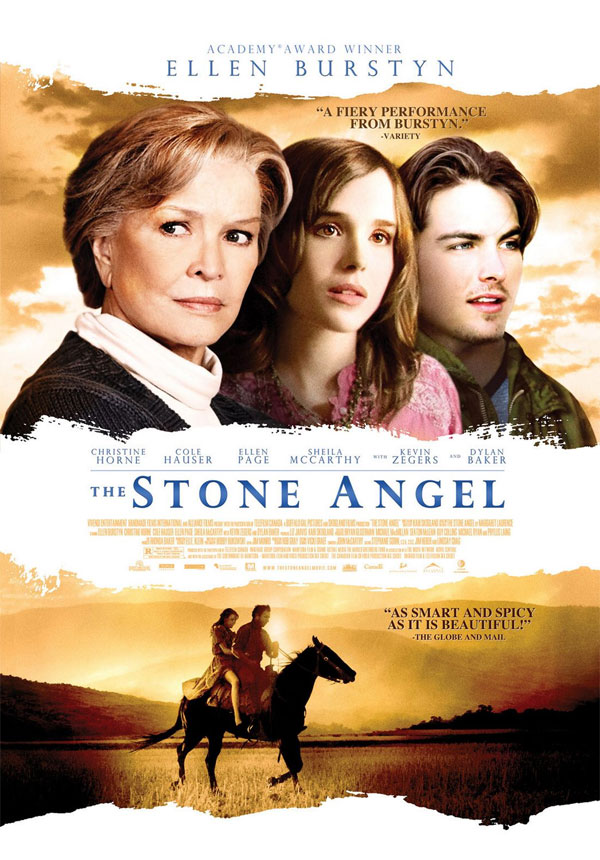
And on that note, I'm going to mention I finished reading The Stone Angel a couple days ago.


I kind of can't believe I only discovered Margaret Laurence this year. Like, can I really have called myself a book snob before 2009 if I hadn't read Laurence? I love her. I love that reading her work makes me feel more connected to Canadian history, and specifically a younger kind of Canadian history that starts west of southern Ontario. I am charmed and made uncomfortable by her characters, their loves, their mistakes, and their never-resting unhappiness with their lives. I loved The Diviners, I liked A Jest of God, and I fricking can't believe I lived before meeting Hagar Shipley. Could there be a character more self-aware, regretful and watchful, who also manages to know absolutely nothing of herself? I actually laughed out loud in one spot of the book, when she is drinking with a stranger in an abandoned fish warehouse; he tells her of his wife, she says, "Well, the poor thing.... Fancy spending your whole life worrying what people were thinking. She must have had a rather weak character." (p. 227)


Ah, Margaret Laurence -- how you winked at your readers.

2008-12-18

two months, three weeks, three nights

"A woman, if she is to write, Virginia Woolf once said, (or words to that effect), must have a room of her own. The garret bit never appealed to Morag unduly, but by God, it is at least a room of her own." p. 294

I'm just back from a short bit of lovely, homey holidays. Quiet days spent in southern B.C., where the snow was falling and wind whipping and I had every excuse in the world to wrap myself up in a blanket and read Margaret Laurence's The Diviners.

I have to tell you, I've found a new author to obsess over.

Laurence's work -- no surprise for any fan of CanLit -- is frankly brilliant. Thirty-four years after first publication, The Diviners still reads as absolutely ground-breaking. I marvel at the painful honesty with which Laurence treats her heroine, Morag Gunn.

This is the story of a woman who longs for something just out of reach, always. In the deep of the Depression, she wants to have money. In the heart of a loving but disgustingly poor home -- and Laurence marvels in the dusty, grungy, smelly corners of this small Manitoba home -- Morag wants to be clean, to smell good, to be smiled upon by fortune and neighbours.

"'I want to be glamorous and adored and get married and have kids. I still try to kid myself that I don't want that. But I do. I want all that. As well. All I want is everything,'" (p. 182) Morag tells her friend.

In finding herself, Gunn learns all the uses of a man. I don't mean that to sound shallow or vulgar. What I mean is, this is no romance novel. This is no tale of happily ever after.

In marriage, she wants to know her husband absolutely. Completely. She wants to be his equal, she wants him to take care of her. She wants a child. And so, over time, she learns man can be provider. Lover. Father. Friend. One-night stand. A man can be used for what a woman needs, the way a woman can be used for what a man needs.

For me, the haunting aspect of the novel is that, sometimes, a lifelong search can leave your hands empty. Depending on what you're looking for. I know that sounds cryptic, but I don't want to ruin this novel for you if you've not read it. On my little holiday alone, I read over the book almost three times. Before I'd gotten halfway through, I needed to go back and skim through again, review for lost clues. Once finished, I read it all one more time, studying Laurence's great attention to the importance of culture and personal or imagined history. Her decision to use sex as illustration of loneliness, love, isolation and one woman's choice to drop everything expected of her.

I'm not the first or last person to analyze Margaret Laurence. And, you could probably find much better analysis in a high school English class. But I was so very moved by the rich detail.

"You can't go home again, said Thomas Wolfe. Morag wonders now if it may be the reverse which is true. You have to go home again, in some way or other. This concept cannot yet be looked at." p. 302

2008-12-06

  1. How glad am I that blogger.com doesn't allow you to see how many people read your stuff? When it comes to this little space in the world wide web, I'm pleasantly clueless as to who really reads my posts. A couple friends, my parents.... I'll never know and I'm totally cool with that. My work blog, on the other hand, presents a dashboard that makes me absolutely crazy. I am bizarrely driven to load stuff onto the site in hopes of watching numbers go up, not down. This must be -- almost -- what it's like to be a TV reporter and have to live through sweeps. Gah.
  2. Less about my neuroses, let's look at other people's.
  3. This bookshelf reminds me of Lost. Only 46 more days until the season premiere!
  4. Reading Margaret Laurence's The Diviners, I'm struck by how fake most descriptions of the Depression are when written by people who didn't live it. Sorry, that's a little unfair. Elizabeth Hay's A Student of Weather certainly speaks to a sheer grittiness of the times, and Richard B. Wright's Clara Callan covers off a sense of hopelessness. But Laurence's work is something else. You can almost smell the times in the pages. No one in Morag's childhood is beautiful, not even a little bit. Laurence does not put makeup on these people, she does not make them better than they are. She gives them massive fault lines that you could absolutely sink into if not for the fact she brings you back to her present (the 1970s) again and again.
  5. I think we'd all like to know a little bit more about how this blind date ended. Because I'm thinking it couldn't have lasted very long. Perhaps Quebec's best friend called her on the phone to make sure she could escape after 30 minutes if things weren't going well. Yes, girls do do that.
  6. More poetry, please. It's what a good life needs.